
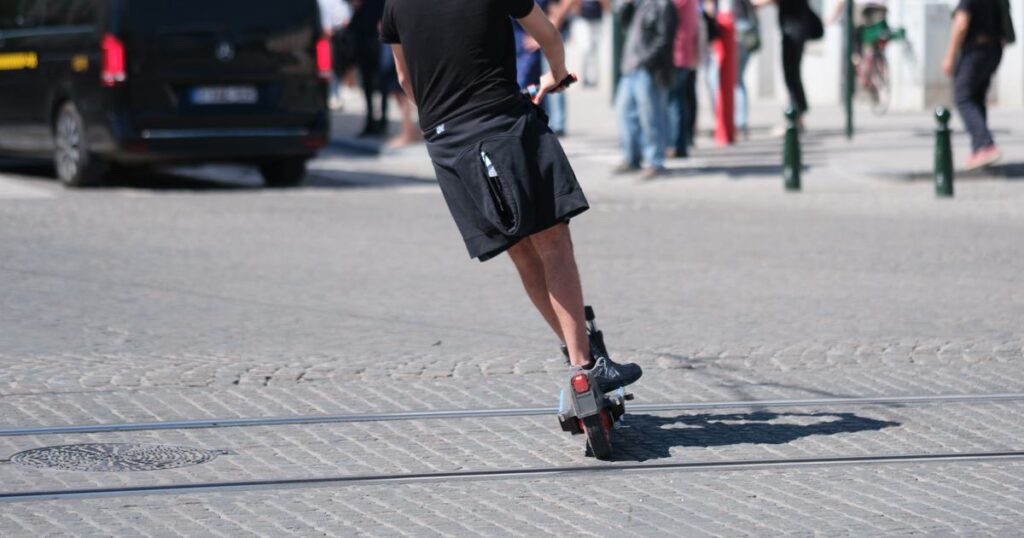
The changes would directly affect people riding and walking in Budapest, including in Erzsébetváros, the city’s District VII. An article published by Economx on 3 November noted, however, that several questions about enforcing the planned rules have yet to be settled.
E-scooters would be divided into two categories
Under the government proposal, motorised scooters would fall into two groups. Lower-powered models would include vehicles capable of travelling at no more than 25 kilometres per hour. The minimum age for riding them would be 14, while riders under 18 would have to wear protective headgear.
Any scooter capable of exceeding 25 kilometres per hour would fall into the higher-powered category. Riders would have to be at least 16 and hold, at minimum, the type of driving licence required for mopeds and scooters. A motorcycle helmet would be compulsory, and the maximum permitted speed would be 40 kilometres per hour.
Rental e-scooters would have their top speed limited to 20 kilometres per hour.
On pavements, pedestrians would set the pace
Speaking to InfoRádió, driving instructor Attila Pető said one of the most disputed issues could be where lower-powered scooters are allowed to travel. The proposal would permit them to use the pavement if no other option were available, but Pető argued that a speed of 25 kilometres per hour could not be considered safe there.
He recommended that riders always adapt their speed to pedestrian traffic when using a pavement. In practice, that would mean travelling at roughly 5–10 kilometres per hour. In urban areas, he considers cycle lanes or cycle paths the safest option.
Who will measure the speed and identify the rider?
Although the draft would set clear figures and age limits, Pető said it was not yet apparent how the authorities could enforce them consistently. It remains unclear how an e-scooter’s speed would be measured, how an offending rider would be stopped, or how a vehicle without a registration plate or other identifier could be traced.
As an example, he asked what would happen if a 12-year-old were caught riding an e-scooter when the proposed minimum age was 14. A similar issue would arise if someone travelled at 30 kilometres per hour where the limit was 25. In Pető’s view, clear penalties would be needed to prevent riders from ignoring the rules.
Economx wrote that during the first five months of 2026, Hungary recorded 61 per cent more injury collisions caused by e-scooter riders than in the same period a year earlier. This increase has been cited as the reason for introducing stricter rules.
The government is accepting comments on the proposed legislation until 5 November.
Source: Economx