Dániel Varga, a Fidesz councillor in District I and an external member of the Budapest Assembly’s Committee for Climate Protection, Transport and Urban Development, has proposed that plans for the memorial be prepared alongside the renovation of Petőfi híd, Index reported.
The committee is due to discuss the motion on Wednesday, 11 November. If members approve it, the proposal could go before the Budapest Assembly at its regular November meeting. The motion does not authorise construction or provide funding; at this stage, it concerns planning only.
Why raise the idea now?
Preparations for the renovation of Petőfi híd are already under way. The design programme envisages restoring elements of the bridge’s original 1937 appearance, but explicitly excludes the naval memorial.
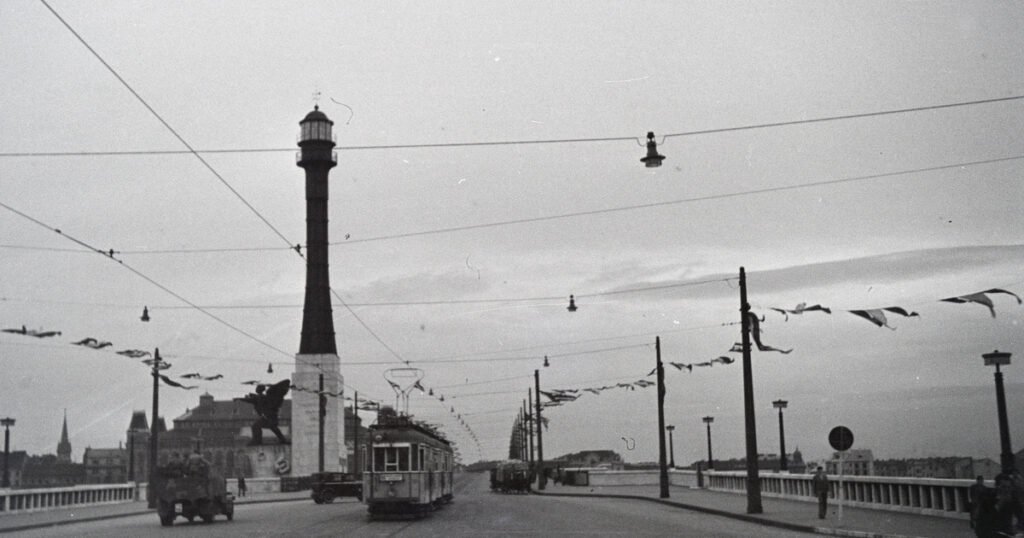
Varga told Index that the timing was dictated by engineering considerations. He argued that the monument’s base formed an integral part of the bridge pier on the Buda riverbank, making it technically and financially impractical to treat the two projects separately. In his view, once the current plans are finalised, the chance to reconstruct the memorial could be lost for decades.
He said earlier Budapest projects had taken priority, citing the renovation of Margit híd, the construction of Buda’s interconnected tram network and the restoration of Lánchíd.
Under his proposal, planners would assess the technical requirements and likely cost of rebuilding the monument. The study could also examine a visitor centre, accessibility, the possible reopening of the lighthouse and the revival of the structure’s former museum function.
Varga maintains that the monument commemorated Hungarians who served in the navy of the Austro-Hungarian Monarchy. He regards its reconstruction as an act of remembrance and believes it could also become a visitor attraction.
Naval memorial or symbol of the Horthy era?
Opponents of the proposal interpret the monument’s historical meaning differently.
Balázs Balogh, a Budapest Assembly member for the Tisza Party, described it as a memorial to Miklós Horthy, Hungary’s interwar regent, and said he would not support its reconstruction. During the subsequent social media debate, Balogh drew a distinction between creating a new memorial to fallen naval servicemen and rebuilding the original structure. He said the former could be appropriate, but continued to oppose restoring a monument closely associated with Horthy.
Varga rejected that interpretation. He argued that the work commemorated Hungarian naval servicemen as a group, of whom Horthy was only one. In his view, recasting the proposal as an attempt to restore a political symbol disrespects those whom the memorial honoured.
Tibor Déri, a Budapest Assembly member for the Democratic Coalition, also opposes the motion. He said Hungarian soldiers who died in service deserved remembrance, but argued that this did not justify reconstructing a monumental work from the Horthy period. He regards the restoration of the bridge’s original architectural character and the rebuilding of the memorial as separate issues.
József Gál, parliamentary group leader of the Podmaniczky Movement in the Budapest Assembly, told Index: “We are renovating a bridge, not an era.”
The cityscape is also part of the argument
The Office of the Mayor of Budapest does not support the proposal either. Its position is that while a replica would be technically feasible, rebuilding it could strengthen the cult surrounding Horthy and deepen social divisions. The office described the original monument as an expression of the militarist outlook of the interwar period and said its message would not be broadly acceptable today.
It also raised urban design objections. The area around the Buda bridgehead has changed substantially since the monument disappeared, with new Budapest University of Technology and Economics buildings altering the immediate setting and the MOL tower near Kopaszi-gát becoming a prominent feature of the wider skyline. According to the mayor’s office, the reconstructed monument’s strong vertical form could now appear out of scale with its surroundings.
Index also approached Dávid Vitézy, Hungary’s minister for transport and investment. The ministry said Vitézy had taken part in preparing the bridge renovation, but the memorial had not formed part of that proposal. It added that Petőfi híd is owned and managed by the city, leaving decisions about the project’s technical scope and any reconstruction to the Budapest municipality and the assembly. The ministry did not state whether it supported Varga’s initiative.
The committee meeting on 11 November will therefore not decide whether to build the monument. Members will consider whether its possible reconstruction should be planned. If the committee backs the motion, the debate could continue in the Budapest Assembly.
Source: Index