Telex’s G7 section first mapped the commercial premises between Boráros tér and Jászai Mari tér in November 2022. Of the 662 units counted at the time, 140 offered somewhere to sit down for food or drink. This year’s survey recorded 676 premises, 190 of which belonged to the broader hospitality category.
That category includes cafés, tearooms, confectioneries and bakeries with seating, as well as restaurants and bars. Once vacant premises are excluded, while food shops, convenience stores and the boulevard’s nine tobacco shops are included, one in every three commercial units along this four-kilometre stretch on the Pest side is connected in some way to food or drink.
Café numbers have doubled
The shift has accelerated particularly sharply over the past 12 months. In four years, the number of restaurants rose from 65 to 96. Café numbers doubled from 13 to 26, with nine new businesses joining that category in the past year alone.
The boundaries between different types of business are also becoming less distinct. Telex found hybrid venues where tea plays a larger role than coffee, as well as a large beauty salon where customers can sit down and order refreshments.
Traditional retail is moving in the opposite direction. There are fewer clothing and shoe shops, general electronics retailers and bookshops. Small mobile phone stores and hairdressers are also declining. Among beauty services, only cosmetics and nail salons have expanded.
Other businesses have proved far more resilient. Large drugstore chains, pharmacies, tobacco shops, lottery outlets, bank branches and opticians have remained largely unaffected by market shifts. Currency exchanges frequently change their names or locations, yet their number has stayed remarkably stable at around 25.
Blaha Lujza tér remains the dividing line
There are striking differences between individual sections of the Grand Boulevard. Erzsébet körút, running along the edge of Budapest’s party district in District VII, has the highest concentration of places serving food and drink. This is where the transformation of the shopping street into a line of restaurants, bars and cafés is most pronounced.
Blaha Lujza tér remains a clear dividing line. According to the survey, József körút, which runs south from the square, is the least sought-after section, and vacant commercial premises are more concentrated there.
In the years after the pandemic, empty storefronts shaped much of the boulevard’s appearance. At the end of 2022, Telex counted almost 130 vacant premises. That figure gradually fell to 60 by 2025 and has remained at roughly the same level over the past 12 months.
The latest survey identified 34 premises that had already been empty a year earlier. Twenty-one previously vacant units had found tenants, while 28 businesses had closed, leaving their premises available to let. After several units were merged or divided, the number of vacant properties increased by only two.
New paving, more trees and tidier pavements
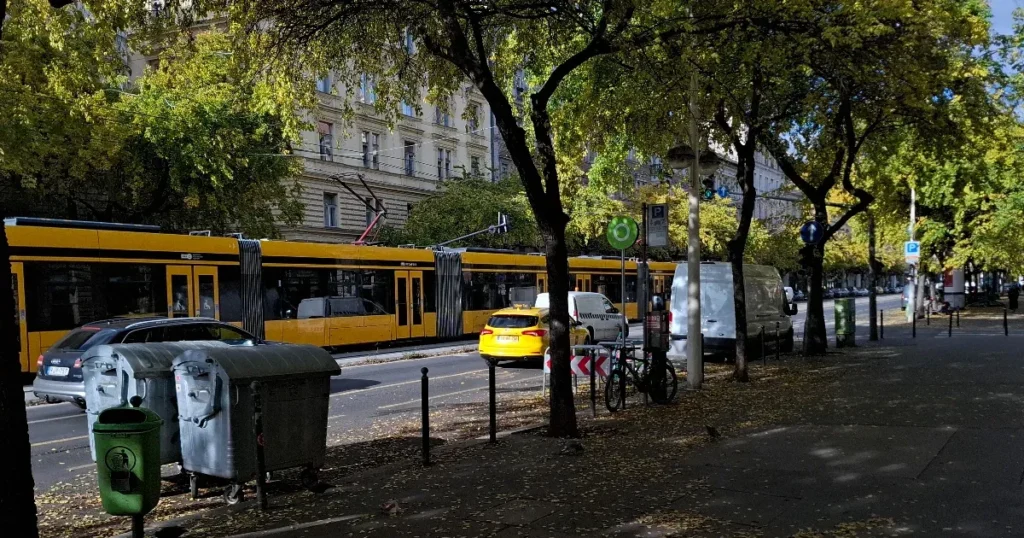
The next major shift could come with the reconstruction of the Grand Boulevard. A coordinated renewal of the section between Nyugati tér and Boráros tér could begin within a year, or by early 2028 at the latest. Szent István körút will not be included for the time being.
Balogh Samu, public-space development programme manager at the Budapest Transport Centre (BKK), told Telex that technical planning and preparations were moving ahead intensively. He said EU funding would provide most of the project’s financial backing.
Under the current plans, the parking lane and cycle lane will change places along almost the entire affected Pest-side section by mid-2029. The road surface will be renewed, pavements will receive consistent stone paving, benches will be installed and more greenery added. According to Balogh, only diseased trees that cannot be saved will be removed, and at least three new trees will be planted for every one cut down.
Short-stay parking bays are planned for drivers, while digital signs will show the availability of spaces in nearby car parks and underground garages. The redesigned boulevard is intended to make walking and cycling more comfortable. Restaurants and cafés will not receive additional space for terraces; instead, a measured reorganisation of existing terraces is expected.
The approaching construction work has not yet triggered visible competition for commercial premises. Of the boulevard’s roughly 670 properties, around 100 undergo some form of change each year, and that figure has not increased. Telex’s survey found no sign that retailers and hospitality businesses are rushing to secure premises before the boulevard is renewed.
Under the current timetable, construction between Nyugati tér and Boráros tér could begin within a year, or by early 2028 at the latest, with completion expected by mid-2029.
Source: Telex