
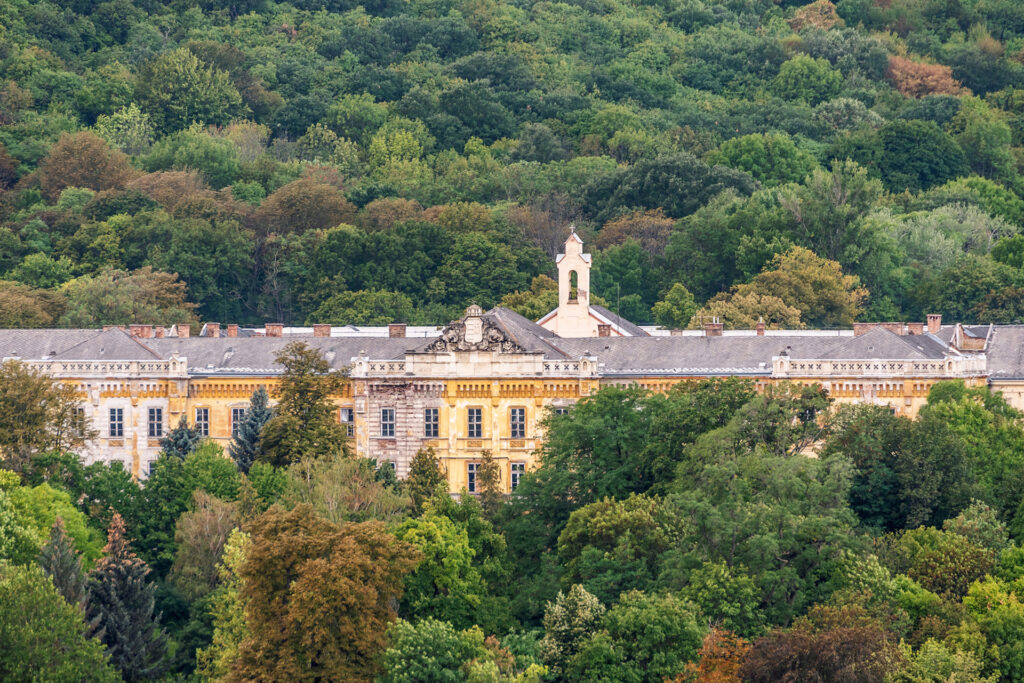
In an article published on 3 November, Építészfórum cited District II mayor Gergely Őrsi as saying that the municipality was prepared to take responsibility for maintaining the two apartment buildings at the edge of the grounds. They are currently home to former OPNI employees and their descendants.
Under the proposal, the buildings would contain social and staff rental homes, primarily for people working in healthcare and education. The mayor described the plan as a way to provide affordable, good-quality housing.
A playground in a corner of the park
The proposal also includes a playground, which the surrounding neighbourhood currently lacks. It would occupy a small part of the former institute’s park, alongside a recreation area open to nearby residents.
Őrsi approached both the previous and the new government in writing. According to the mayor, Dávid Vitézy, Hungary’s minister for transport and investment, responded positively, opening the way for talks between the government and the District II municipality.
No decision has yet been made to carry out the project, and details of any construction work have not been announced.
An institute, a museum and residential buildings
Originally known as the Országos Tébolyda, or National Asylum, the institution was commissioned by Emperor Franz Joseph I. The complex was built to designs by Lajos Zettl between 1859 and 1863 and opened in 1868. Its late Romantic architecture combines Romanesque, Gothic, Arab and Moorish elements.
The institute treated psychiatric and neurological patients until 2007. It also housed the Pszichiátriai Képtár-Múzeum, a museum collection of paintings, drawings and other works by psychiatric patients.
OPNI closed on 31 December 2007. The decision was justified on the grounds that the building was unsuitable for patient care and could not be operated economically. The Hungarian National Committee of ICOMOS opposed the closure, citing the institution’s historical significance and the value of its museum collection.
An abandoned school project and a lengthy legal dispute
For years, there was no settled plan for the site. In 2020–2021, a proposal emerged to convert it into an elite boarding school. Építészfórum reported that former OPNI staff and their relatives living in the old staff homes faced eviction as preparations for that project moved ahead.
The dispute continued through the courts for several years. According to Építészfórum, the last OPNI tenant involved won their case in 2024. The boarding school was never built.
The latest proposal would retain the two residential buildings. Talks between the municipality and the government may be the next step, but the staff housing, playground and recreation area remain plans rather than an approved development.
Source: Építészfórum