According to a 7 November article by Kontroll, the issue became a national controversy in mid-April. Among the larger cities, asbestos-bearing aggregate was first identified in Szombathely. Contamination was later detected in Kőszeg, while the affected material was also found to have been delivered to Zalaegerszeg and Sopron.
Németh Martin, a municipal representative in Bük, previously obtained data from Hungary’s National Tax and Customs Administration. The figures indicated that around 250 municipalities in western Hungary could be affected. He published both a list of settlements and a map showing where the aggregate was delivered and in what quantities.
Greenpeace has launched a separate interactive map displaying contaminated sites documented by the organisation and the authorities, along with areas where remediation has already been completed. Residents can also submit reports through the platform.
Kontroll explained that asbestos does not pose a health risk while it remains bound inside the rock. If the aggregate is crushed through repeated vehicle traffic, however, the likelihood of dust being released increases. Airborne asbestos fibres can then travel beyond the immediate site.
A HUF 3 billion fund with strict conditions
The Hungarian government established a HUF 3 billion Asbestos Remediation Fund under government resolution 1257/2026 of 14 August. It is intended primarily for municipalities where aggregate from quarries in Burgenland has created an environmental and public-health risk.
Applicants must have an asbestos map, while measurements are required to demonstrate the health risk. Further tests must be carried out after remediation to show that the work has been effective.
In Sopron, tests conducted by the municipality and the Győr-Moson-Sopron County Government Office have identified contamination at 66 public sites, including roads, verges and car parks. The municipality said the material had often been laid outside properties by owners or contractors, spreading it onto roads maintained by the city.
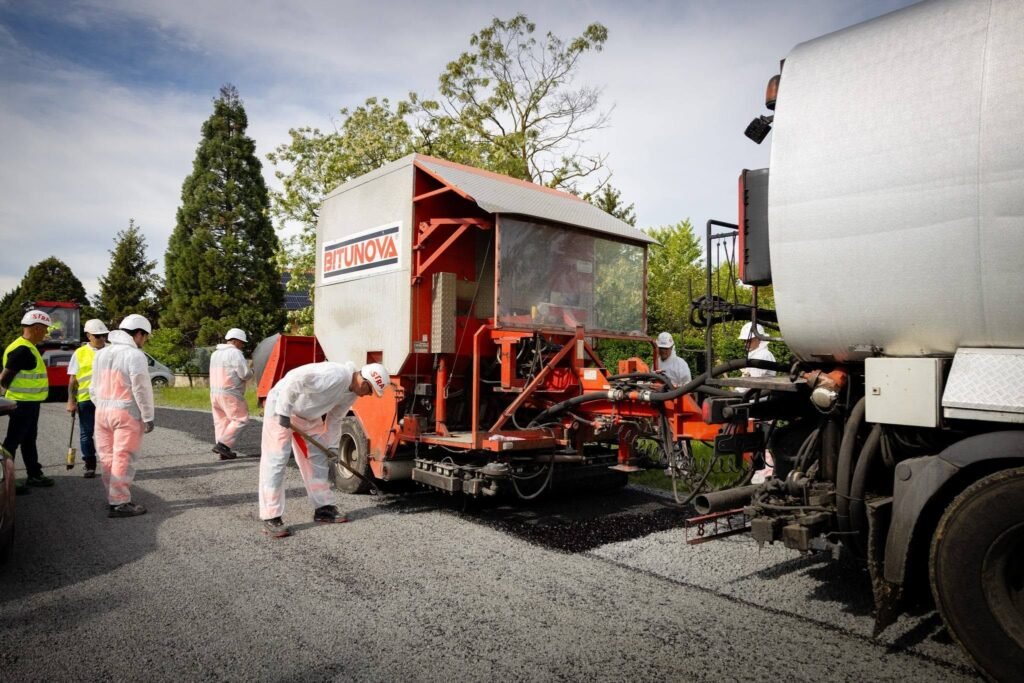
Speed restrictions and no-entry signs have been installed on affected road sections, while calcium chloride is being used to suppress dust. The treatment retains moisture in the road surface and reduces dust formation, but it is not a substitute for permanent remediation. Further air-quality tests are needed to assess how effective it has been.
Sopron has spent around HUF 70 million gross from its own budget and set aside another HUF 90 million as its contribution to the state programme. Full remediation is estimated to cost close to HUF 400 million.
On 7 October, the city wrote to the relevant minister and state secretary, asking for a review of eligibility rules, the required municipal contribution and the application deadline. Sopron’s press office told Kontroll that no reply had arrived from the ministry by the time the article was published.
Hundreds of locations identified in Szombathely
In Szombathely, attention initially focused on the Oladi Plató neighbourhood. Asbestos was found in aggregate intended for road foundations, and tests in the surrounding area also detected asbestos fibres in the air.
Municipal figures identify contamination at 317 locations, affecting 331 separate properties and a total surface area of 287,274 square metres. Alpok Terra Kft. is carrying out work to stop dust emissions along 74,700 square metres of transport routes in Oladi Plató.
Surface sealing is also under way at another 110 sites that are open to public traffic or owned by the municipality, covering 92,242 square metres. This work is due to be completed by 4 December.
The same method cannot be used on road verges, as the municipality says covering them could create accident risks and structural damage. Around 7,205 square metres of contaminated verges have been identified at 33 locations. Here, the affected stone must be removed, transported away and disposed of. The estimated gross cost is HUF 856,663,260, and the work is expected to take 10–12 months.
Szombathely submitted its application on 14 October, offering to cover 10 per cent of the cost. The municipality estimated the full programme at HUF 2.48 billion gross. If the bid succeeds, measures intended to stop dust emissions could be completed on 97 per cent of the affected municipally owned land.
A further 5,143 square metres of low-risk municipal land would require work in 2027. Intervention is also considered necessary across 19,595 square metres owned by private individuals, churches, the state or residential associations.
Dispute over air testing
Neményi András, the mayor of Szombathely, criticised what he described as a retrospective change to the funding rules. He told the city assembly that work could now be recognised only at sites where accredited tests had detected asbestos fibres in the air.
According to the mayor, Szombathely would need 317 such tests. At HUF 1.5 million per test, the total cost would be HUF 475.5 million. Neményi argued that the country does not have sufficient testing capacity and that weather conditions could affect the results. He also questioned how retrospective air tests could be conducted at sites that had already been sealed to prevent fibres from entering the air.
In his view, the requirement could jeopardise the city’s application for around HUF 2.5 billion in funding, towards which Szombathely has offered a 10 per cent contribution. The mayor said the city had already paid nearly HUF 1.5 billion for bitumen sealing work in Oladi Plató and elsewhere.
The municipality also noted that its asbestos map captures only a particular moment in time. New reports are still being submitted to the Mayor’s Office.
Source: Kontroll