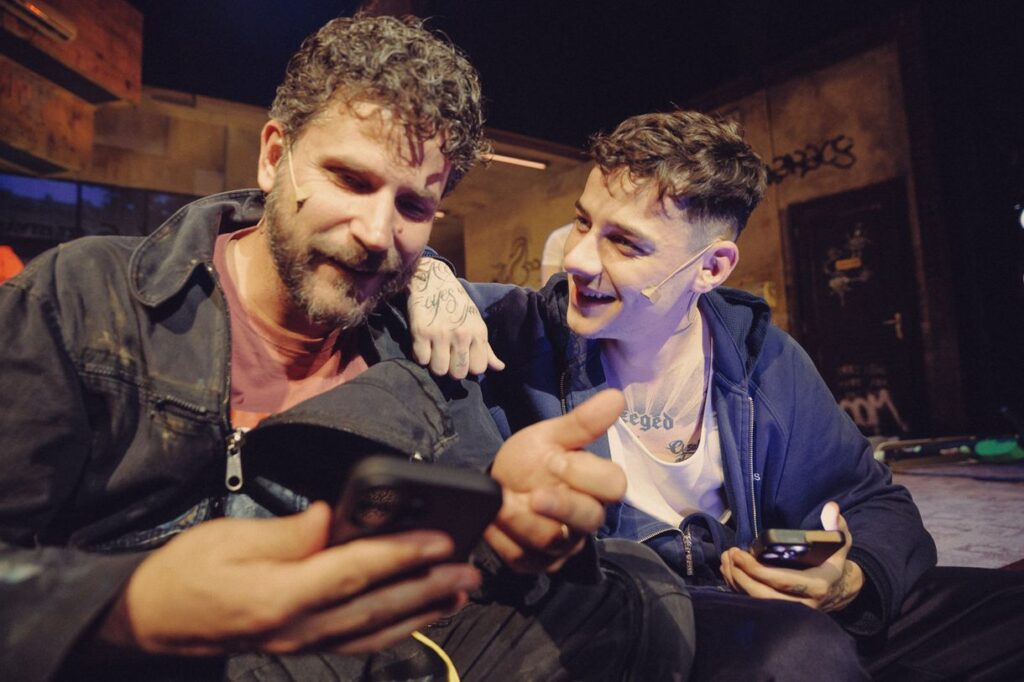
The Grand Boulevard is also the everyday city backdrop of Erzsébetváros residents: screeching trams, shops and pubs open through the night, and different stories drifting side by side. Attila Vidnyánszky Jr.'s production 4-6 brings this world to the main stage of the Vígszínház.
The title refers both to the boulevard tram and to the pub where the play is set. Zita Schnábel's set puts scribbled-on walls, urinals and grimy washbasins next to the bar. Even the interval is part of the stage world: the audience can do graffiti, and Pogány Induló gives a concert standing on the bar.
## A whole pub's worth of people
At the start of the story, a girl who has moved to Budapest from the countryside and dropped out of university starts working behind the bar. Réka Ágota Gál's character spends a year in this place, where almost everyone passes through: a laborer, a junk scavenger, a football fan, an accountant and a tax inspector.
The owner is played by Patrícia Kovács, with a striking hairdo, makeup and a look imitating cosmetic surgery. A regular at the pub is Pogány Induló, real name Marcell Szirmai. It soon turns out that he is the son of the constantly drunk Márta, played by Tünde Majsai-Nyilas.
Several dramatic stories could unfold from the relationships between the characters. Two men compete for the barmaid, and alcoholism has driven a wedge between Márta and her son. A conservative father also appears who doesn't understand the world of his liberal daughter and her partner.
According to the HVG critic, these situations merely flash by rather than developing into a story. The actors portray the characters accurately, but they are given few opportunities for their characters’ emotions and decisions to truly influence the course of events.
## Scrolling on Stage
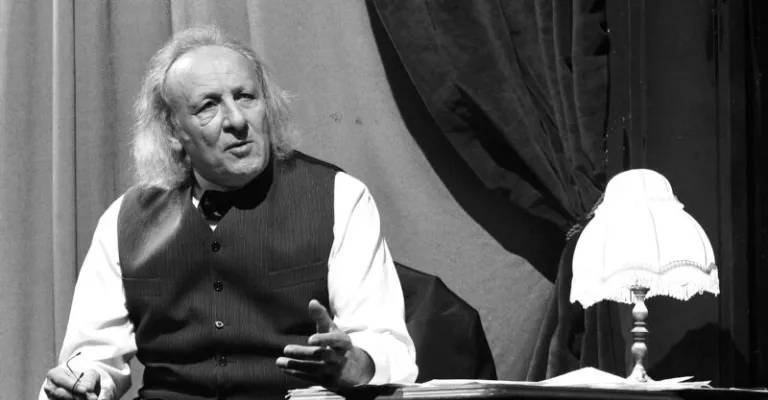
The company is credited as the author of 4-6, and the script was prepared by dramaturg Nikolett Németh. The scenes were presumably assembled from improvisations by the actors and the director. This differs from Attila Vidnyánszky Jr.'s previous production at the Vígszínház, @LL3t4rgIA, for which Büchner's Leonce and Lena provided the story framework.
This production is driven by rapid transitions. No sooner does one scene end than the next character, gag, or musical idea appears, as if the audience were scrolling through short videos. The HVG review compares this to the rhythm of TikTok and doomscrolling.
The humor often works. Characters crawl out of a scavenged television, a Hungarian tax inspector chats in Arabic with the food courier, and Pogány Induló's own songs become a target too. According to the review, the costumes, the scenes using contemporary dance and the actors' character portraits are also among the stronger parts of the production.
## Young people in the velvet seats
The Vígszínház's historic auditorium filled up with teenagers too, drawn by Pogány Induló's name and a form close to social media. Bálint Kovács considers this a serious achievement of the production: people are talking about 4-6, and the show has become an event.
The critic’s sense of something missing stems from the fact that he found few well-developed ideas behind the attention-grabbing form. Although the play touches on alcoholism, family conflict, exclusionary rhetoric, and what it means to be Hungarian today, the critic feels that these issues do not go beyond an initial raising of the topic.
According to HVG's review, 4-6 is an entertaining evening full of visual ideas and jokes that land. Still, the review finds that while the production successfully transfers the quick stimuli of social media to the stage, it does not develop the characters' fates or the social tensions it raises.
Source: HVG