
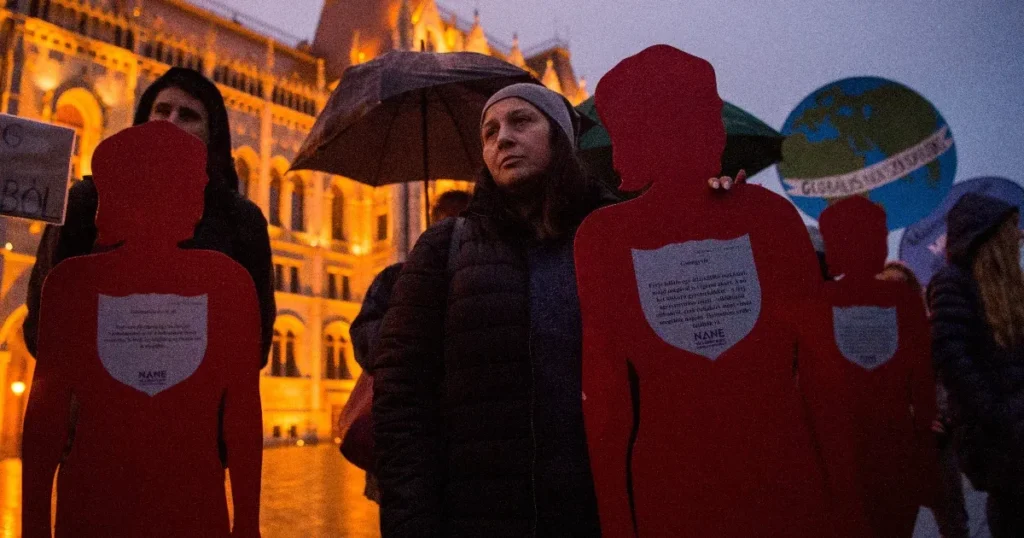
NANE, the Women for Women Together Against Violence Association, said the move would make up for twelve years of inaction. In its analysis, Telex looked at what incorporating the international treaty into Hungarian law would entail and why supporters and opponents assess it so differently.
Signed, but never made part of Hungarian law
The Council of Europe adopted the convention in 2011. It treats violence against women as a violation of human rights and a form of discrimination, and sets out specific duties for participating states. These cover prevention, support for survivors and action by public authorities.
Hungary signed the convention on 14 March 2014. The signature signalled the government’s intention at the time, but the treaty was not subsequently ratified and therefore did not become binding under Hungarian law. The government’s position shifted in the following years, and it openly opposed ratification from 2019. In March 2020, the governing majority in parliament voted against incorporating the convention into Hungarian law.
Judit Varga, who was justice minister at the time, argued that the treaty’s requirements on prevention and victim protection had already been incorporated into Hungarian legislation. Gergely Gulyás, chancellery minister in the previous government, said last year that Hungarian law already contained all the necessary safeguards for women.
Alexandra Szentkirályi, an MP for the opposition Fidesz party, responded to Magyar’s announcement by pointing to the restraining orders, special treatment and victim support centres that already exist. She also argued that Hungarian rules are stricter than the convention in several areas.
Women’s rights groups, by contrast, have long maintained that Hungary’s victim protection system is inadequate.
Four areas covered by the convention
The Istanbul Convention rests on four pillars. The first is prevention. This includes training professionals who come into contact with survivors so that they do not blame or retraumatise them. States would also have to provide public information about different forms of violence and the support available.
The second pillar is protection and support. Where there is an immediate danger, the authorities would have the power to remove an alleged perpetrator from the shared home straight away. The convention also extends the group of people who can be protected by restraining orders beyond relatives to former and casual partners. Survivors could receive legal advice, psychological assistance and financial support where needed.
The third area is holding perpetrators accountable. Investigations and court proceedings would have to be conducted without unjustified delay, while respecting the survivor’s rights at every stage.
The fourth pillar requires public institutions to work together. Courts, police, social services and civil society organisations would be expected to coordinate their response. This would require a comprehensive government strategy, adequate funding and sufficient trained staff.
There is no complete professional consensus on how Hungarian law compares with the convention. A Lakmusz fact-check cited by Telex quoted criminal lawyers who argued that Hungary’s Criminal Code and other legislation meet the treaty’s requirements and in some respects go further. The same analysis nevertheless identified several areas where Hungarian rules do not fully match the convention.
One disputed issue is the requirement for a private motion by the survivor. In Hungary, proceedings over sexual coercion, certain cases of sexual violence and bodily harm resulting in injuries that heal within eight days can currently begin only at the victim’s request. Under the convention, the opening of an investigation could not depend solely on whether the survivor files a complaint.
Gender, education and asylum in the political debate
Fidesz–KDNP politicians have previously objected to the convention’s definition of gender and its provisions on asylum. Christian Democratic politicians have described it as promoting a damaging gender perspective. In a post on Friday, Szentkirályi argued that the document interprets gender through socially constructed roles and forms of behaviour.
Article 12 of the convention deals with the social and cultural behaviour patterns of women and men. Participating states would undertake to encourage changes that reduce prejudices and harmful practices based on the idea that women are inferior or on rigid gender stereotypes. The document also calls on men and boys to play an active part in preventing violence.
Its education provisions call for age-appropriate teaching materials suited to pupils’ developing abilities. The subjects include equality between women and men, mutual respect, non-violent conflict resolution and the right to personal integrity.
The convention’s chapter on migration and asylum includes the principle of non-refoulement. This means that a woman who has suffered abuse could not be returned to a country where she would face serious danger, torture or inhuman treatment.
Ratification would involve more than a parliamentary vote. Hungary would have to amend legislation, develop institutions, provide financial and human resources, and report regularly on implementation. Compliance would be monitored by GREVIO, the Council of Europe’s independent expert body. GREVIO is neither a court nor a law enforcement agency and cannot impose fines or other sanctions. Its influence comes through its reports, public scrutiny and pressure on participating states.
Source: Telex