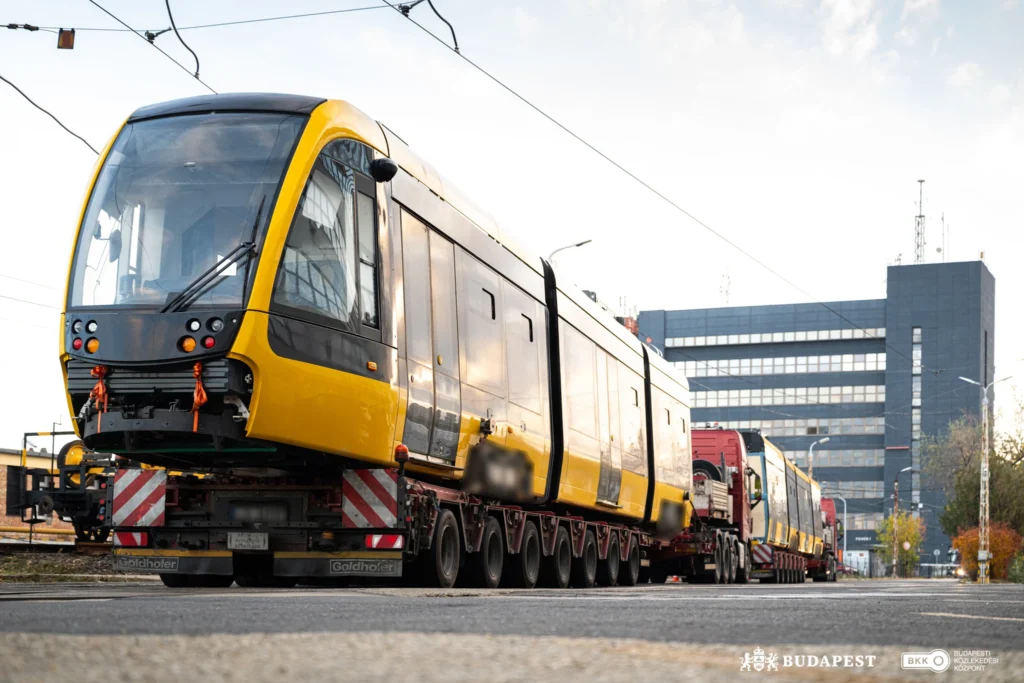
Five long trams are due to arrive under the current procurement programme. The second is now in Budapest, and the Budapest Transport Centre (BKK) says the third will follow soon.
Inspections before passenger service
The new tram cannot enter passenger service immediately. Technical checks and official examinations will begin after its arrival in Budapest, followed by the licensing procedure. It will be allowed to carry passengers on tram route 1 only once that process has been completed successfully.
The first new long CAF delivered to the city has already completed the required trial runs. It must still pass the remaining technical and licensing stages before entering service.
Specialists from BKK and Budapest’s public transport operator, BKV, inspected the vehicles at the Spanish factory before shipment. Over several days, they examined the technical design, installed equipment, wiring and connections, as well as the passenger compartment and driver’s cab. They also checked whether the completed trams met the contractual, technical and quality requirements.
Capacity for 345 passengers
Each nine-section tram is almost 56 metres long and can carry 345 passengers, with 81 seats. The air-conditioned interior is open-plan and low-floor throughout, allowing passengers to move along the full length of the vehicle without steps.
Energy generated during braking can be fed back into the overhead power network. Compared with Budapest’s earlier CAF trams, the new vehicles also feature changes to the bodywork, doors and interior panels.
Their high capacity is intended to meet demand on the busy tram route 1. An initial 12 nine-section CAF Urbos 3 trams were delivered to Budapest, followed later by another five. The five long vehicles in the current order will join them.
A fleet expansion of 51 CAF trams
The long trams form part of a wider procurement programme covering 51 vehicles. Funding of HUF 11.287 billion from the non-repayable IKOP Plus programme covers six trams, while the other 45 are being purchased using HUF 42.863 billion in EU funding through the RRF programme. The project is supported by the European Union and co-financed by the Hungarian state.
Further vehicles from the order are arriving in Budapest on an ongoing basis and are at different stages of inspection and licensing. According to BKK, the procurement will raise the proportion of low-floor vehicles in Budapest’s operating tram fleet to more than 40 per cent.
Source: BKK – Hírek